
Foundation Workshop on Basic Research Methodology
Foundation Workshop on Basic Research Methodology An Academic Foundation for Aspiring Researchers The Bangladesh Research Society (BDRS) is pleased to announce the Foundation Workshop on Basic Research Methodology, a focused academic workshop designed to equip students and emerging researchers with the essential knowledge, skills, and mindset required to begin their research journey with greater confidence and methodological clarity. Research begins with more than simply selecting a topic. It requires the ability to identify a meaningful research problem, critically engage with existing literature, formulate focused research questions, select an appropriate methodological approach, collect evidence systematically, and communicate research ideas in a structured academic manner. This workshop will provide participants with a structured overview of the research process, combining foundational concepts with practical guidance on research problem identification, literature review, research design, data collection, proposal development, and introductory data analysis. The program is particularly designed for those who are new to academic research, preparing to undertake thesis or research projects, or seeking to develop a systematic understanding of research methodology. WORKSHOP INFORMATION Particular Details Workshop Title Foundation Workshop on Basic Research Methodology Date August 29, 2026 (Saturday) Time 3:00 PM – 6:00 PM Venue Serajul Islam Lecture Hall, Lecture Theatre, University of Dhaka Workshop Modules Module I — Foundations of Research & Research Mindset The opening module introduces the conceptual foundations of academic research and the intellectual approach required for effective inquiry. Key Areas: Understanding the nature, purpose, and significance of research Major types and approaches of research Developing a critical and research-oriented mindset Principles of research ethics and academic integrity Module II — Research Problem Identification & Literature Review A strong study begins with a well-defined research problem and a critical understanding of existing knowledge. This module focuses on the early stages of research development. Key Areas: Selecting and refining a research topic Identifying research problems and knowledge gaps Developing research questions and research objectives Understanding the structure and purpose of a literature review Approaches to conducting an effective and focused literature review Module III — Research Design & Data Collection This module introduces participants to methodological decision-making and the selection of appropriate research designs and data collection strategies. Key Areas: Understanding research design Qualitative, quantitative, and mixed-methods approaches Basic sampling concepts and techniques Selecting appropriate data collection methods and tools Ethical considerations in research and data collection Module IV — Research Proposal Development & Introduction to Data Analysis The concluding module connects research planning with practical research execution and introduces the fundamentals of analyzing research data. Key Areas: Structure and essential components of a research proposal Principles of effective proposal writing Introduction to quantitative data analysis Introduction to qualitative data analysis Connecting research questions with analytical approaches Interactive Questions & Answers WHAT PARTICIPANTS WILL RECEIVE Certificate of Participation Workshop Materials Notepad & Pen Refreshments Post-Workshop Mentorship Registration Information Category Registration Fee Students BDT 350 Others BDT 500 Registration Deadline: August 26, 2026 Register Now WHO IS THIS WORKSHOP FOR? The workshop is particularly relevant to: Undergraduate Students Graduate Students Thesis & Dissertation Aspirants Aspiring Researchers Early-Career Researchers Students preparing to undertake research projects Anyone seeking a structured introduction to research methodology No Prior Research Experience Required The workshop is designed as a foundation-level academic program and is suitable for participants who are at the beginning of their research journey. Payment Information Payment Method: Send Money bKash / Nagad: 01917558417 Participants are requested to follow the payment instructions carefully. Important: Participants must mention their own name in the Reference field while making the payment. After completing the payment, participants must submit the Registration Form to confirm their participation in the course. Contact Email: bdresearchsociety@gmail.com For registration-related queries and further information, participants may contact the Bangladesh Research Society through the official email address.
Basic Data Analysis Course on R for Students & Young Researcher
Basic Data Analysis Course on R for Students & Young Researchers The Bangladesh Research Society (BDRS) is pleased to announce the “Basic Data Analysis Course on R for Students & Young Researchers”, a practical, research-oriented training program designed to develop participants’ foundational and applied skills in R Programming, Statistical Analysis, Data Visualization, and Research Data Management. In contemporary academic research, proficiency in data analysis and statistical programming has become increasingly important for students, thesis researchers, and early-career researchers. R is an open-source statistical programming language and a widely used research platform for quantitative research, survey data analysis, thesis and dissertation research, statistical modelling, data visualization, and reproducible research workflows. This course has been designed not merely to introduce participants to R as a software tool, but to develop the ability to work with research data through the complete analytical process—from data preparation and cleaning to statistical analysis, visualization, interpretation, modelling, and research-oriented reporting. About the Course The course will provide a structured introduction to the R Programming Language and RStudio environment, followed by practical applications in research data analysis and statistical modelling. Participants will work with research-oriented datasets and practical exercises to develop a clear understanding of how data can be managed, analyzed, visualized, interpreted and presented for academic and research purposes. The training will follow a hands-on and project-based learning approach, enabling participants to apply the concepts learned in real or simulated research contexts. Course Objectives By completing this course, participants will be able to: Develop a foundational understanding of R Programming and RStudio. Import, export, manage, clean, and preprocess research datasets. Perform descriptive and inferential statistical analyses using R. Generate appropriate and informative research data visualizations. Conduct correlation, hypothesis testing, regression, and ANOVA. Understand and apply selected statistical modelling techniques. Perform basic time-series, forecasting, and panel-data analysis. Assess statistical model assumptions and diagnostics. Apply structured statistical workflows to research datasets. Present and communicate analytical findings in a research-oriented manner. Course Contents Module 01: R Programming & RStudio Introduction to R and RStudio R environment and workspace Basic R syntax and programming concepts Objects, functions, operators, and packages Working with scripts and reproducible workflows Module 02: Data Import, Export & Management Importing data into R Exporting datasets and analytical outputs Working with CSV, Excel and other common data formats Data structures and basic data management Variable and dataset organization Module 03: Data Types & Variable Management Numeric, character, logical and categorical data Factors and variable coding Missing values Variable transformation and recoding Module 04: Data Cleaning & Preprocessing Identifying and handling missing data Detecting inconsistent and invalid values Data transformation Filtering, sorting and restructuring datasets Preparing datasets for statistical analysis Module 05: Descriptive Statistics & Frequency Analysis Measures of central tendency Measures of dispersion Frequency distributions Cross-tabulation Summary statistics Exploratory Data Analysis (EDA) Module 06: Data Visualization Principles of research data visualization Bar charts, histograms, boxplots and scatterplots Distribution and relationship visualization Advanced visualization using ggplot2 Presenting publication-oriented analytical graphics Module 07: Correlation & Association Analysis Pearson and Spearman correlation Association between variables Correlation matrices Interpretation and reporting Module 08: Hypothesis Testing Research hypotheses and statistical hypotheses Parametric and non-parametric testing t-tests and related procedures Interpretation of statistical significance Effect size and practical interpretation Module 09: Linear Regression Analysis Simple and multiple linear regression Model estimation and interpretation Regression coefficients Model fit and explanatory power Interpretation of regression outputs Module 10: Logistic Regression & Classification Introduction to logistic regression Binary outcome modelling Odds and odds ratios Model interpretation Basic classification concepts Module 11: ANOVA & Post-hoc Analysis One-way ANOVA Group comparison Post-hoc testing Assumption assessment Interpretation and reporting Module 12: Time Series Analysis & Forecasting Introduction to time-series data Trends and seasonality Time-series visualization Basic forecasting concepts Practical forecasting applications Module 13: Panel Data Analysis Introduction to panel datasets Structure of panel data Basic panel-data concepts Practical analytical workflow Module 14: Statistical Model Diagnostics & Assumption Testing Model assumptions Residual diagnostics Multicollinearity Normality and homoscedasticity Model evaluation and interpretation Module 15: Applied Data Analysis & Statistical Workflows Research-oriented analytical workflow Selecting appropriate statistical methods From research question to statistical analysis Interpreting analytical results Organizing outputs for academic research Module 16: Capstone Data Analysis Project Research dataset selection Data preparation Statistical analysis Visualization Interpretation of findings Research-oriented presentation of results Final Session: Review, Q&A & Live Project Comprehensive course review Participant questions and discussion Live data-analysis exercise Project presentation and feedback Learning Format & Course Benefits Participants enrolled in the program will receive: 16+ Live and Recorded Interactive Sessions 3 Practical Projects with Assignments Hands-on experience with research datasets Project-Based Learning Approach Practical training in research-oriented data analysis Classes conducted three days per week Certificate of Completion Performance Recognition for outstanding participants The course is designed to balance conceptual understanding with practical application, enabling participants to develop skills that can be directly applied to thesis research, academic projects, survey research, quantitative studies, and other research activities. Class Schedule Class Days: Saturday, Monday & WednesdayTime: 10:00 PM – 11:00 PMTime Zone: Bangladesh Standard Time (BST) Registration Information Category Registration Fee BDRS Society Members BDT 900 Non-Members BDT 1,500 Registration Deadline: September 25, 2026 Register Now Who Is Eligible for BDRS Membership Benefits? The Bangladesh Research Society (BDRS) extends its membership benefits to students, researchers, and academic enthusiasts who have recently participated in BDRS activities or are members of affiliated university-based research societies and research clubs. You may avail BDRS Member Benefits if you meet any one of the following criteria: 1. Recent BDRS Participants If you have participated in any course, training, workshop, or academic program organized by BDRS within the last 12 months, your valid certificate, confirmation document or proof of participation will be recognized for BDRS membership benefits. 2. Members of Affiliated Research Societies & Research Clubs Members of the following research societies and research clubs are also eligible for BDRS Member Benefits: Bangladesh Research Society (BDRS) Dhaka University Research Society (DURS) Rajshahi University Research Society (RURS) BUP Research Society Barishal University Research Society (BURS) JKKNIU Research
Basic Data Analysis Course on STATA
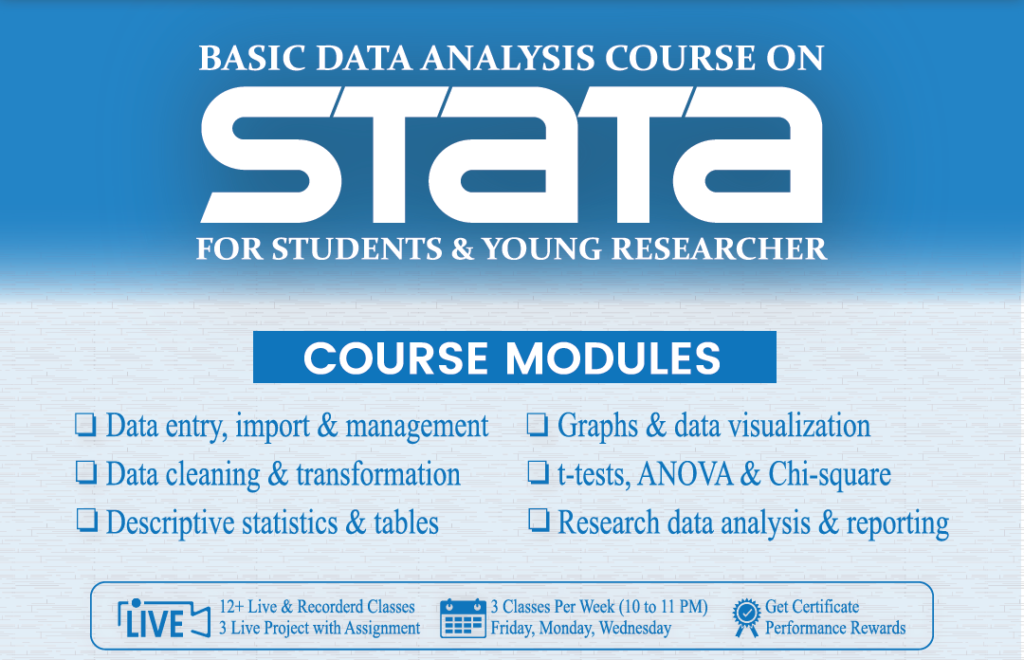
Basic Data Analysis Course on STATA The Bangladesh Research Society (BDRS), in collaboration with the Global Institute for Research & Development (GiRD), is pleased to announce the enrollment of its “Basic Data Analysis Course on STATA” designed for students, early-career researchers, and academic professionals. This course aims to provide participants with practical and research-oriented skills in quantitative data analysis using STATA. Through interactive live sessions, hands-on assignments, and applied project work, participants will gain foundational competencies essential for academic research and professional data analysis. Course Modules: Data Entry, Import, and Management Data Cleaning and Transformation Descriptive Statistics and Data Tables Graphical Presentation and Data Visualization t-tests, ANOVA, and Chi-square Analysis Research Data Analysis and Reporting Course Features: 12+ Live and Recorded Classes 3 Practical Project-Based Assignments Classes Three Days per Week Schedule: Friday, Monday & Wednesday Time: 10:00 PM – 11:00 PM Certificate of Completion and Performance Recognition Registration Information Registration Fee: Society Members: 490 BDT Others: 990 BDT Registration Deadline: 5 June 2026 Register Now Payment Information Send payment via Bkash / Nagad to:>> 01917558417 Please write << your name in the reference section>> during payment.After payment, complete the registration form to confirm your seat. Limited Seats Available | Registration will be confirmed on a first-come, first-served basis. We warmly encourage students, thesis researchers, and young academics interested in strengthening their research and statistical analysis skills to participate in this course. Contact Email: bdresearchsociety@gmail.com Upgrade Your Research Skills | Learn STATA | Master Data Analysis | Strengthen Your Academic Career
BASIC DATA ANALYSIS COURSE USING IBM SPSS
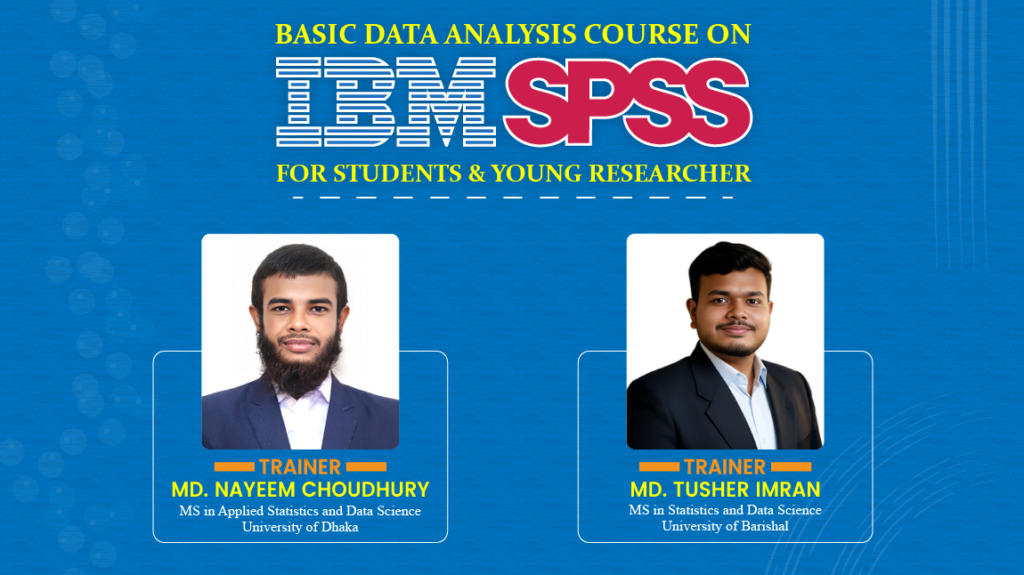
BASIC DATA ANALYSIS COURSE USING IBM SPSS Are you a university student, thesis researcher, or young researcher in Bangladesh struggling with data analysis, statistics, or IBM SPSS for your academic research? The Bangladesh Research Society (BDRS) is pleased to announce the reopening of registration for the Basic Data Analysis Course Using IBM SPSS—a structured, practical, and research-oriented training program designed to strengthen statistical competence, quantitative research skills, and data analysis capacity among university students, thesis students, and young researchers. The course is designed to introduce participants to SPSS from the fundamentals and gradually develop their ability to conduct statistical analyses commonly used in academic and quantitative research. WHY SHOULD YOU JOIN THIS COURSE? Through this training, participants will have the opportunity to: Learn IBM SPSS step-by-step, from beginner to applied research level Understand statistical techniques commonly used in academic research Gain practical experience in data cleaning, management, visualization, and analysis Develop skills in hypothesis testing, correlation, regression, and ANOVA Understand how to design and execute a complete research data analysis workflow Strengthen quantitative research and statistical analysis skills Apply SPSS to thesis, dissertation, survey, and academic research Receive an official course completion certificate PROGRAM DETAILS Title Details Course Title Basic Data Analysis Course Using IBM SPSS Duration Approximately 2 Months Total Classes 12 Live Sessions Class Frequency 3 Classes per Week Class Time 10:00 PM – 11:00 PM Course Start Date 13 April 2026 (Monday) Mode Live Online Classes Platform Google Meet The class schedule may be adjusted when necessary. WHAT WILL YOU LEARN? 1. Introduction to IBM SPSS Introduction to SPSS and its research applications SPSS interface and basic operations Data View and Variable View Creating and managing research datasets 2. Data Importing, Cleaning & Management Importing datasets into SPSS Variable coding and labeling Data cleaning and preparation Missing-value management Data transformation and recoding 3. Descriptive Statistics Frequency analysis Measures of central tendency Measures of dispersion Descriptive summaries Interpretation of statistical outputs 4. Normality Testing Understanding distribution and normality Normality assessment Interpretation of normality tests Implications for statistical analysis 5. Data Visualization Bar charts Histograms Boxplots Pie charts Scatterplots Research-oriented graphical presentation 6. Hypothesis Testing Research and statistical hypotheses Significance testing Parametric and non-parametric approaches Interpretation of p-values and statistical significance 7. Chi-Square & Correlation Analysis Chi-Square test of association Pearson correlation Relationship between variables Interpretation and reporting of results 8. Regression Analysis Simple and multiple linear regression Regression coefficients Model interpretation Logistic regression Practical applications in quantitative research 9. ANOVA Analysis of Variance Comparing multiple groups Interpretation of ANOVA results Post-analysis interpretation 10. Complete Research Data Analysis Workflow From research question to statistical analysis Selecting appropriate statistical techniques Running analyses in SPSS Interpreting statistical outputs Presenting results for academic research 11. Final Project Practical research dataset Complete data analysis Interpretation of findings Research-oriented presentation of results 12. Comprehensive Review Course review Practical problem-solving Participant Q&A Final guidance for independent research data analysis WHO CAN APPLY? This course is open to: University Students — Undergraduate & Master’s Thesis and Dissertation Students Young Researchers Early-Career Professionals interested in Data Analysis Students and researchers seeking practical SPSS skills Individuals interested in quantitative research and statistics Class Schedule Class Days: Saturday, Monday & WednesdayTime: 10:00 PM – 11:00 PMTime Zone: Bangladesh Standard Time (BST) Registration Information Participant Category Fee Research Society Members BDT 490 Non-Members BDT 990 REGISTRATION DEADLINE: 13 April 2026 Register Now Payment Information Payment Method: Send Money bKash / Nagad: 01917558417 Participants are requested to follow the payment instructions carefully. Important: Participants must mention their own name in the Reference field while making the payment. After completing the payment, participants must submit the Registration Form to confirm their participation in the course. Contact Email: bdresearchsociety@gmail.com For registration-related queries and further information, participants may contact the Bangladesh Research Society through the official email address.